
Finding Spartanburg Resident Records
Use the record keyed to the fact in hand. An address works well in the county parcel systems. A deed book and page points to a recorded instrument. A case number belongs in the court index. A historic surname belongs in a dated directory or obituary index. Those paths can overlap, but their meanings do not. A property owner is not automatically an occupant, and a party named on a filing is not automatically a current resident. Comparing the date, role, place, and record type keeps a Spartanburg resident search grounded.
Start narrowly, then add an independent record. A parcel can supply the legal description that distinguishes similar street names. A deed can supply the parties and recording date. A directory line can add an address for one published year. When a record is unavailable online, the county office, library, or a focused records request is the next channel rather than a reason to guess.
- Begin with the county property search when an address, parcel, or owner surname is known.
- Save the parcel identifier, legal description, deed reference, and date context before moving to another database.
- Use the Register of Deeds index for a document trail, narrowing by party role, category, or date when needed.
- Use the Kennedy Room or its digital collection for a dated household clue, then retain the year and page.
- Ask the custodian for a non-exempt record when the online index points to a counter, mail, or appointment route.
Note: A second source should confirm a specific fact, not merely repeat an untested spelling or address fragment.
Spartanburg Resident Records Offices
Spartanburg County keeps the property, recorded-document, court, probate, and election paths in different offices. The assessor and GIS tools help identify a parcel. The Register of Deeds holds recorded documents. Courts and Probate preserve case-specific material, while the state election system controls voter verification. For a street-wide parcel trail, the Spartanburg street directory uses the address path in more detail.
County Assessor
Property and parcel records
Spartanburg County, SC
County property portal
Registration and Elections
366 N. Church Street, Suite 1630
Spartanburg, SC 29303
864-596-2549
Spartanburg Parcel Records and Deeds
The Assessor/QPublic record and OneMap are useful starting points for a modern parcel connection. The county CAMA schema includes owner and taxpayer fields, property location, deed book and page, instrument number, sale clues, subdivision, lot, and legal-description fields. The county separates those fields for good reason. A mailing-style address can be different from the property site, and the taxpayer name can differ from the owner field.
The county cautions that tax information is tied to the December 31 control date. The web data refreshes with recently processed information, but a transfer can take months to appear in tax data. The deed remains the county's stated official ownership record. That makes the parcel page a way to reach the right recorded document, not a substitute for the instrument itself.
- Parcel
- A mapped unit of land identified by the county for assessment and GIS work.
- Situs
- The physical property location, distinct from a tax mailing field.
- Index
- A finding tool that points to a record, not always the record image.
- Legal description
- The lot, subdivision, acreage, or boundary language that anchors land across address changes.
Spartanburg Deed Index Search Fields
The Spartanburg County Register of Deeds search is broader than a surname box. Its name mode allows Standard or Contains Text searching, date or name sorting, and Both, Party 1, or Party 2 roles. Party 1 is the portal's grantor value and Party 2 is its grantee value. The date pair and document categories help separate a likely instrument from a crowded result list.
| ROD control | Use in a Spartanburg search | Limit |
|---|---|---|
| Name mode | Enter a last or company name, with an optional first name. | A name hit needs document context. |
| Party role | Choose both parties, grantor, or grantee. | Role identifies a document party, not occupancy. |
| Date pair | Reduce a search to a known period. | An open date range can be too broad. |
| Book/Page or Instrument | Open the exact reference found on a parcel record. | Image availability varies by record class and period. |
The portal also offers Instrument Types, UCC, Old Index Books, and a temporary index. The temporary index is only a partial processing list and the portal says its indexes are in quality control. Check the resulting document, legal description, and date before connecting it to a Spartanburg address.
The Register of Deeds document index shows the search interface that connects party, book, and instrument routes. Modern image coverage changes by document class, so an older result may require an index-book or office route.
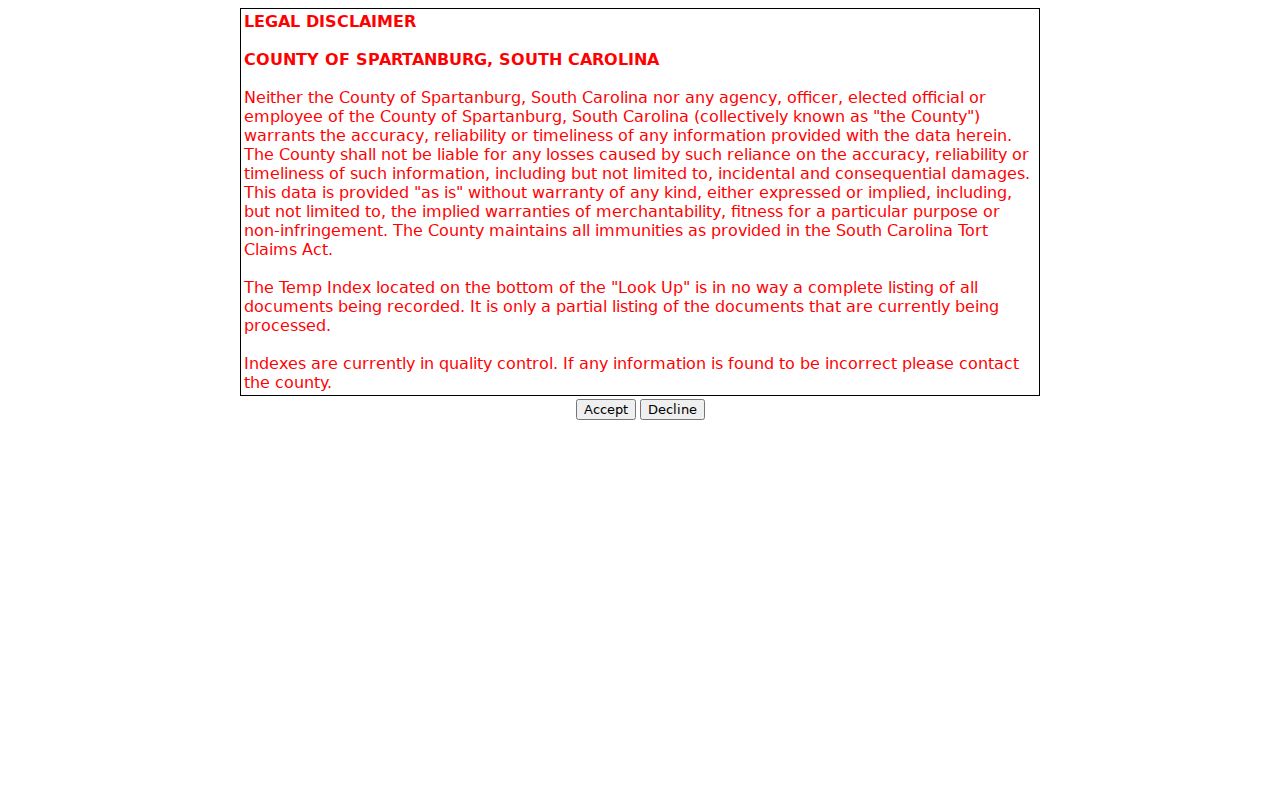
The index is most useful when a parcel pointer or a narrow date range supplies the needed context.
Spartanburg Court Record Verification
The Seventh Judicial Circuit route is the Spartanburg Public Index. It can be narrowed to the county and searched by case number or party/case name, with published Begins With and Contains behavior. Court or agency selection adds useful context because Circuit, Family, Magistrate, and Municipal records have different scope. The result can establish a caption, case number, court, status, type, action history, and, where public, filed material.
It is not a street directory. Sealed, expunged, juvenile, adoption, family, and confidential material may be absent or restricted. Beginning in January 2026, home addresses no longer display on the Public Index for new and existing cases under the judicial and law-enforcement privacy implementation. A physical-file or copy request goes through the Clerk of Court's records process when the online result points to a specific case.
The Public Index landing screen is the county-specific entry point for a party or case search. Selecting Spartanburg before a same-name query reduces the chance of treating a statewide match as a local one.
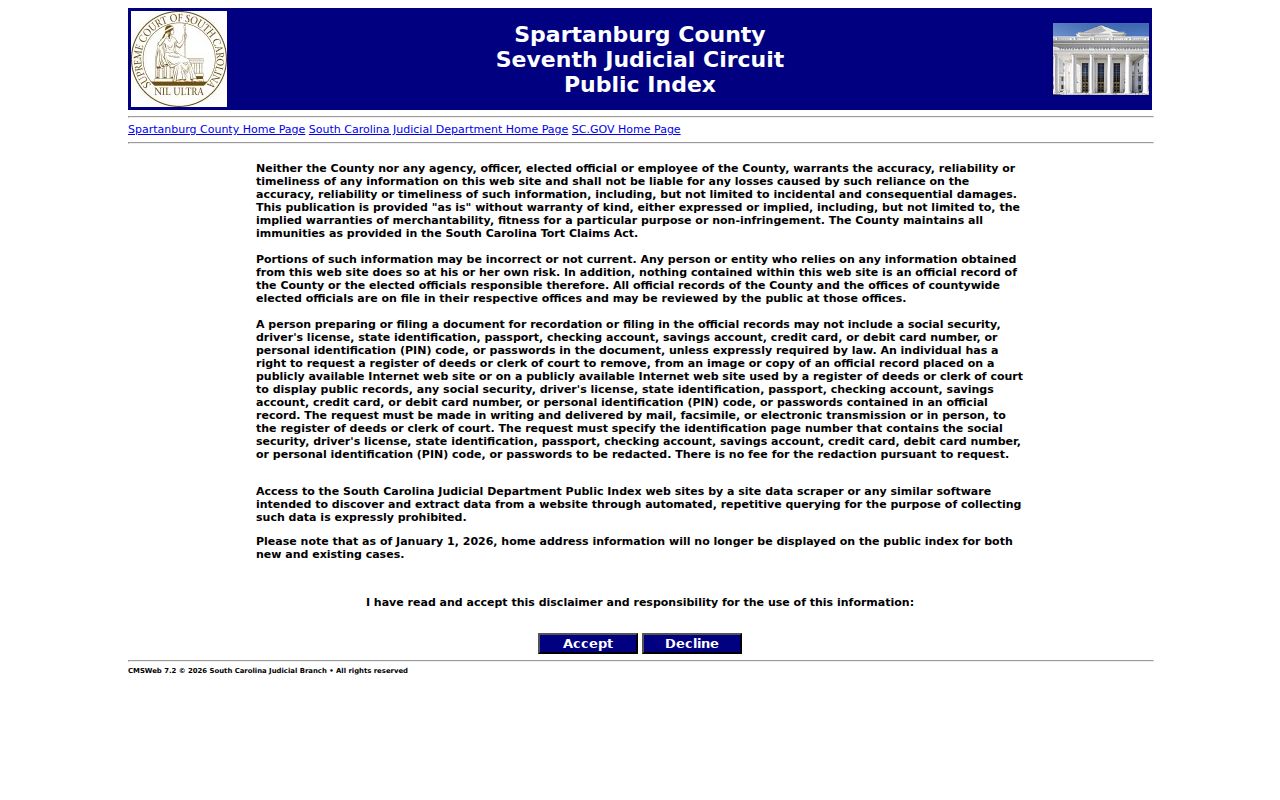
Court information works best as one confirmation within a dated record trail, not as proof of a present address.
Spartanburg Voter Verification Limits
South Carolina's MySCVotes registration check requires a name, county, and date of birth matching the voter registration card. It is a controlled personal verification route, not an open directory by address or street. South Carolina does not use party registration, so no party-registration field should be inferred from a voter search.
The state also sells voter lists under defined eligibility and use rules. A purchaser must be a registered South Carolina voter, and the available criteria can include county, voting district, age, sex, race, household, participation, and registration date. The state warns that public-body personal information cannot knowingly be obtained or used for commercial solicitation. For a precinct or current district question, the Spartanburg County Registration and Elections office is the local counter and phone route.
MySCVotes shows the registration-verification pathway for an individual who can provide the required match data. That boundary protects against turning voter records into a broad resident list.
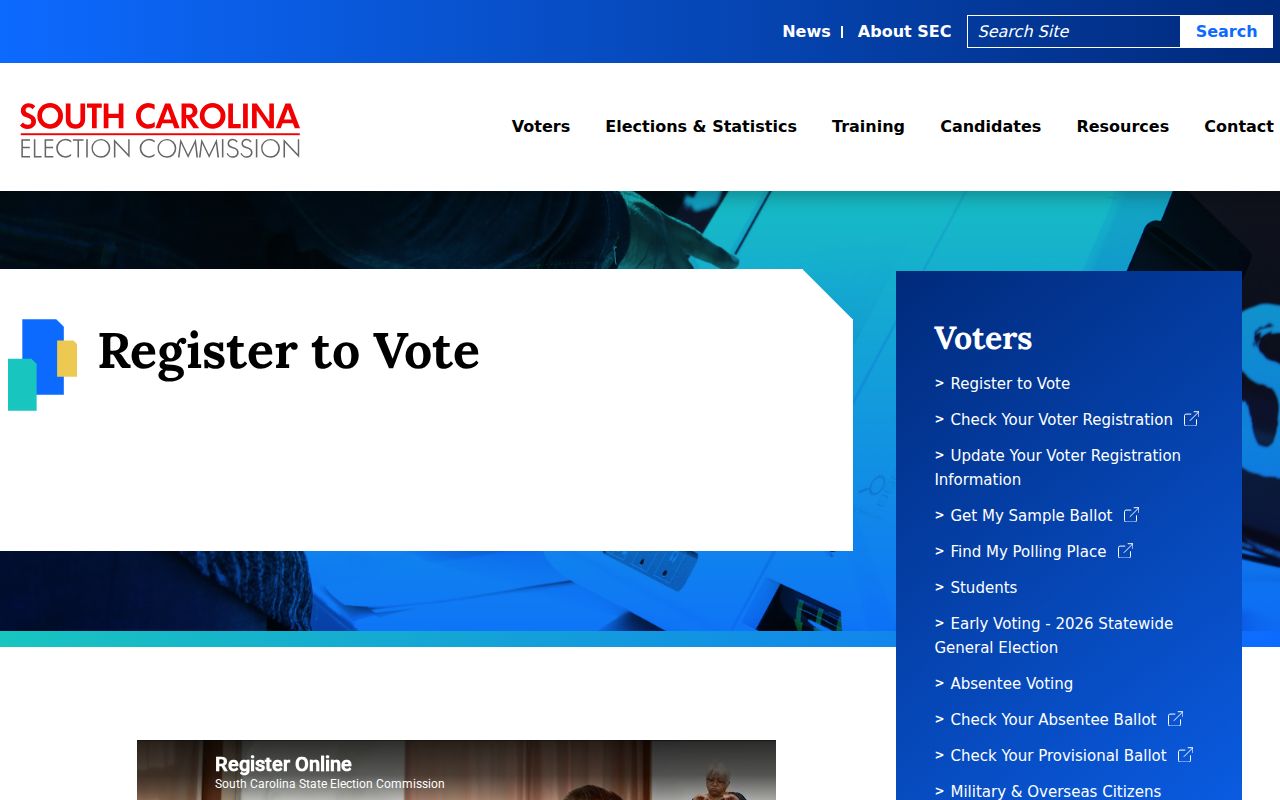
Voter information answers a limited civic-status question for the relevant time, not every question about a household.
Current Spartanburg Resident Sources
There is no single official roll that identifies every Spartanburg household. The usable sources each have a narrow job. Parcel systems describe land and tax fields. Recorded documents identify parties to transactions. Court systems show public case information. Voter and vital-record channels have statutory controls. Treating the boundaries as part of the search produces a more reliable Spartanburg residents directory result.
| Record source | What it establishes | Custodian | Access route |
|---|---|---|---|
| Assessment parcel record | Property, owner/taxpayer, parcel and deed pointers | County Assessor and GIS | Free QPublic or OneMap |
| Recorded instrument | Party role, recording date, legal description | Register of Deeds | Online search, counter, or mail copy |
| Court record | Public case and docket context | Clerk and Judicial Branch | Public Index and records contact |
| Voter status | Verified registration context | State Election Commission | MySCVotes or eligible list order |
| Vital or estate record | Event or probate context within access rules | DPH or Probate Court | Application, office, appointment, or mail |
A commercial directory category may combine fragments from many sources, but it cannot resolve a conflict in a county record. The official record and its custodian remain the place to verify or correct a fact.
Spartanburg Vital Record Time Limits
South Carolina Department of Public Health vital records are not a general name-search catalog. Birth records become public after 100 years and death records after 50 years, then an uncertified copy can be requested with the required application and fee. Earlier certified copies have defined eligibility rules. Marriage and divorce certificates follow their own statutory eligibility rules, and the county Probate Court maintains marriage-license files separately from the state certificate route.
The DPH birth-record page explains the required application, identification, and request channels. The regional office at 118 Dillon Drive serves events from South Carolina counties, but an application must still meet the record's access rules. The Kennedy Room's historical death index and microfilm are a genealogy route, not a way around certified-copy restrictions.
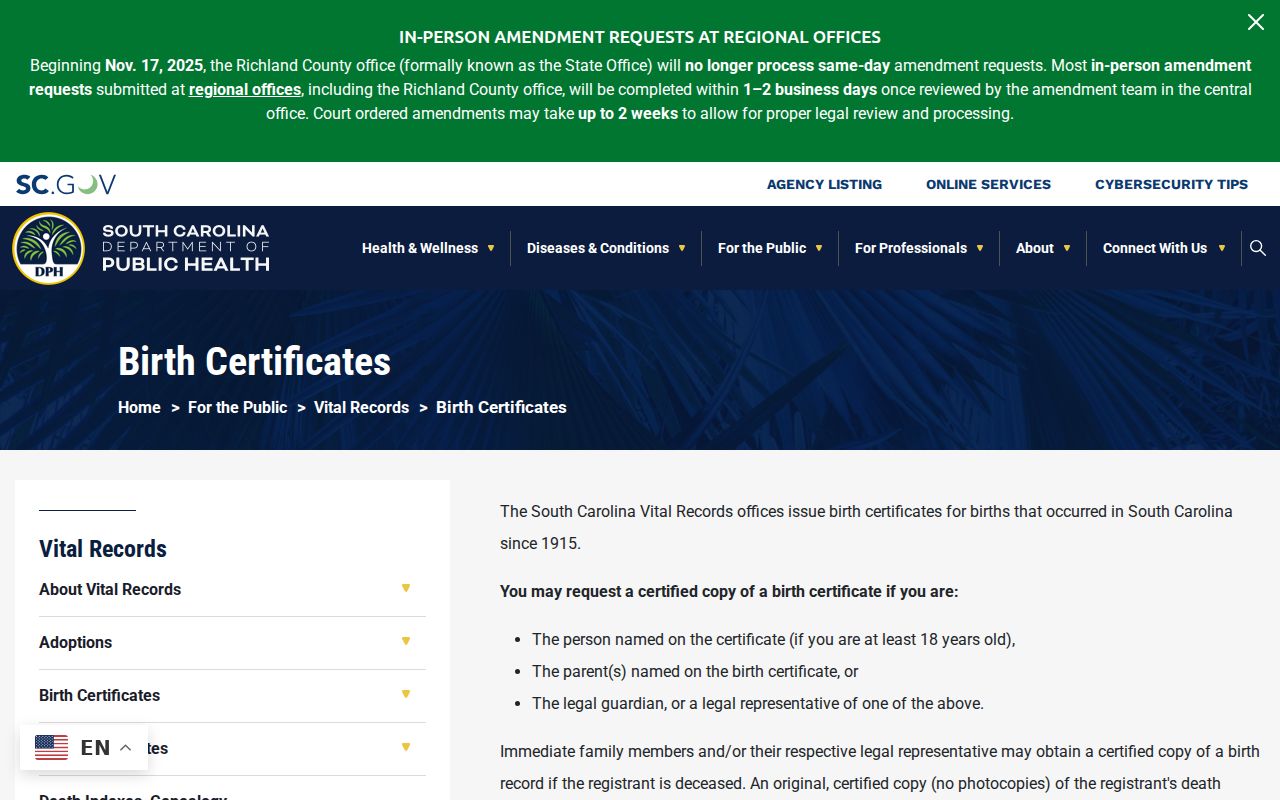
For a historical family question, record the citation and then follow the applicable library, DPH, Probate, or recorded-property channel.
Spartanburg Historical Resident Directories
The Kennedy Room at Spartanburg County Public Libraries is the local shelf for historical names, maps, microform, probate and land research, obituary material, and digitized city directories. The online collection begins with the regional Spartanburg and Greenville Directories of 1880-81 and includes selected volumes through 1956. It is a selected digitization, while the physical Kennedy Room collection may hold more volumes that staff can confirm.
Historical directory lines combine a name with an address, trade notation, spouse or widow notation, route, or neighborhood wording for a particular year. They are dated snapshots, not current rolls. The full collection history and entry-reading method belong in the Spartanburg city directory collection.
The Kennedy Room's local-history page describes its appointment and collection access. Staff can pull requested material before an appointment, and fragile or unprocessed material may have restrictions.
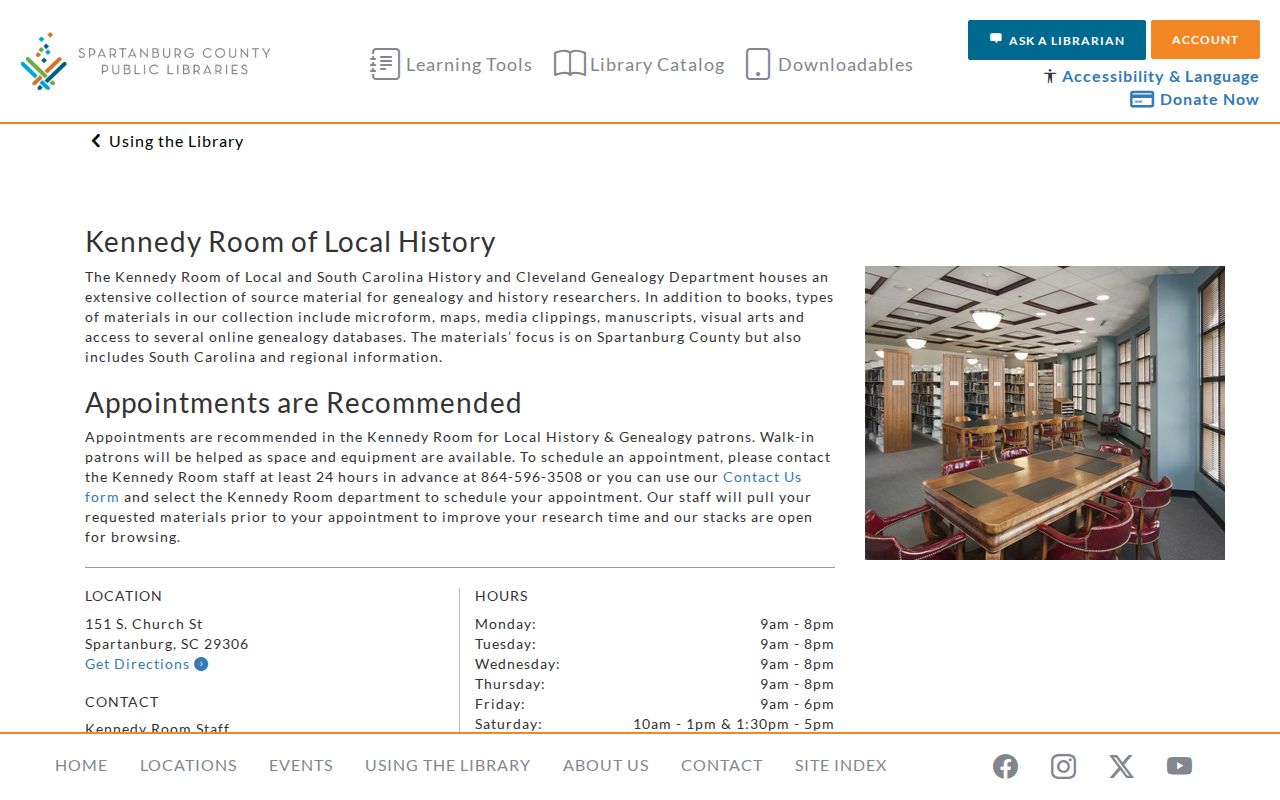
The room also provides a practical bridge from a directory citation to newspaper, land, probate, map, or census material.
Spartanburg Record Access Beyond Portals
A missing online result does not always mean the underlying record is gone. The Register of Deeds accepts counter and mail copy requests when a document is not online. The Clerk of Court provides a records-copy contact for General Sessions, Common Pleas, and Family Court. Probate's research room is open, although viewing a physical file requires an appointment and the request needs identifying case details. The Kennedy Room accepts focused research requests for named land, probate, and newspaper-index checks.
For non-exempt county administrative records, the South Carolina Freedom of Information Act provides another path. Spartanburg County accepts FOIA requests online, by mail, or by fax. The statute imposes response and production timing rules, but it does not override sealed court material, vital-record confidentiality, protected identities, or other exemptions. State archives and library microfilm are also essential when a record pre-dates a modern index.
Note: A focused request that names the record, period, and custodian is more useful than a broad request for all information about a person.
Spartanburg Postal Community Records
County postal geography is not the same as a city limit. The Postal Communities GIS layer carries MSAG community, ZIP, county, state, and postal-city fields. It shows multiple Spartanburg postal polygons and also ties 29385 to both Lyman and Wellford, and 29388 to both Fingerville and Woodruff. Greer 29651 reaches into Spartanburg County even though its postal geography is cross-county.
For a specific mailing address, use USPS ZIP Lookup after County GIS identifies the community context. The ZIP label does not change the county office that keeps a parcel's deed or assessment record. That distinction matters when an old address uses a postal city that differs from its municipal or county record context.
Spartanburg's 1785 Deed Trail
Spartanburg County formed in 1785, and the South Carolina Archives guide identifies county conveyance books beginning that year. The county Register of Deeds portal adds an unusual digital bridge: free modern deed images begin in 1970, while scanned old-index groups reach into earlier eras. The groups overlap, so a researcher needs the period-specific index and the actual legal description rather than a broad assumption that one modern search screen holds the whole history.
That layered record story explains why a past address needs several kinds of evidence. A parcel number moves a modern search toward the correct deed. A grantor or grantee index moves the trail backward. A library directory and census year test whether a household clue fits the period. The oldest material may require the Archives or local research counter rather than an online image.
Spartanburg Property Fraud Alerts
Spartanburg County launched a no-cost Property Fraud Alert service in December 2024. A subscriber can receive an email when a recorded document matches a chosen personal or business name. It is a timely way to learn that a document may need review, but it cannot prevent a fraudulent recording and it is not a title guarantee. Open the actual Register of Deeds record before drawing a conclusion.
Privacy protection also matters. The Address Confidentiality Program, sealed records, redaction rules, and qualifying judicial or law-enforcement privacy requests can lawfully limit what public screens display. An omitted item may be a protected fact, not a broken index.