
Spartanburg Directory Holdings
The strongest starting point is the Spartanburg County Public Libraries digital collection, paired with the Kennedy Room of Local and South Carolina History and Cleveland Genealogy Department. The online collection is useful because its volumes can be searched or browsed without a visit. It is a selected digitization, however, not proof that every directory year has been placed online. The Kennedy Room's physical directory collection is broader than the documented online selection, but its complete shelf run was not published in the official material. Ask staff about a particular later, reverse, criss-cross, or telephone run before treating a missing digital volume as a missing local source.
| Collection | Years | Where Held | Access |
|---|---|---|---|
| Spartanburg and Greenville Directories | 1880-1881 | SCPL ContentDM | Free digitized volume |
| Spartanburg Directory selection | 1896-1897, 1899-1900, 1903-1904, 1905, 1908-1909, 1910, 1911, 1913, 1914, 1916-1917, 1918 | SCPL ContentDM | Free digitized volumes |
| Spartanburg Directory selection | 1920, 1922, 1924, 1926, 1927-1928, 1929, 1930, 1934, 1936, 1938, 1940, 1941, 1945 | SCPL ContentDM | Free digitized volumes |
| Spartanburg Directory selection | 1949-50, 1951, 1954, 1955, 1956 | SCPL ContentDM | Free digitized volumes |
| Kennedy Room physical directory collection | Broader than the digitized selection; exact shelf years need staff confirmation | Kennedy Room | Appointment or browsing access |
| Federal census schedules | 1790-1950 public; Kennedy access documented through 1940 | NARA and Kennedy Room | Public schedules and library resources |
The dated groups above are the documented scans, rather than a continuous run. That distinction matters most between apparently adjacent years. A household may have appeared in an unscanned volume, in a physical-only directory, or under a variant spelling. The directory itself records a period snapshot, so it is best used with the volume year and page kept together in research notes.
Digitized Spartanburg Directory Years
The SCPL city-directory collection describes directories as including alphabetical residents with addresses and trade notation, ordered street addresses, and business material. That mix makes a city directory more than a surname list. A surname can lead to a household address, while an address can be checked in the ordered street portion. A business listing may offer a local context when a name is common. The viewer also makes it possible to record the exact page rather than relying on a result snippet.
The collection supports an early 1880-81 regional volume and intermittent Spartanburg volumes through 1956. It says annual Spartanburg directories began in the 1890s. Those facts fit together: the early item is a regional Spartanburg and Greenville directory, while the later annual city runs form a separate pattern. Gaps in the online sequence should be treated as an access gap, not a finding about whether a person or household existed in Spartanburg County.
The City's public staff directory serves a different purpose. Its first-letter, category, name, and search controls route users to city offices and organizations, not historical households. A municipal resource listing also is not a substitute for the library collection. For a historic person or address, use the dated SCPL and Kennedy Room material; for a city office, use the current municipal directory.
Note: Save the volume year and page with every city-directory transcription so a later reader can check the same edition.
Spartanburg Directory Sample Inventory
The 1954 Hill Directory Company volume is a concrete example of how much material one directory can contain. SCPL identifies it as Spartanburg Directory, 1954, a 1,005-page volume from the Kennedy Room source call number S917.5729 Spartanburg 1954. The digital object has 522 paired and cover scans. Its alphabetical pages place same-surname entries together, sometimes with display listings in between, so the whole line matters more than the surname alone.
The source image below comes from the SCPL 1954 directory object.
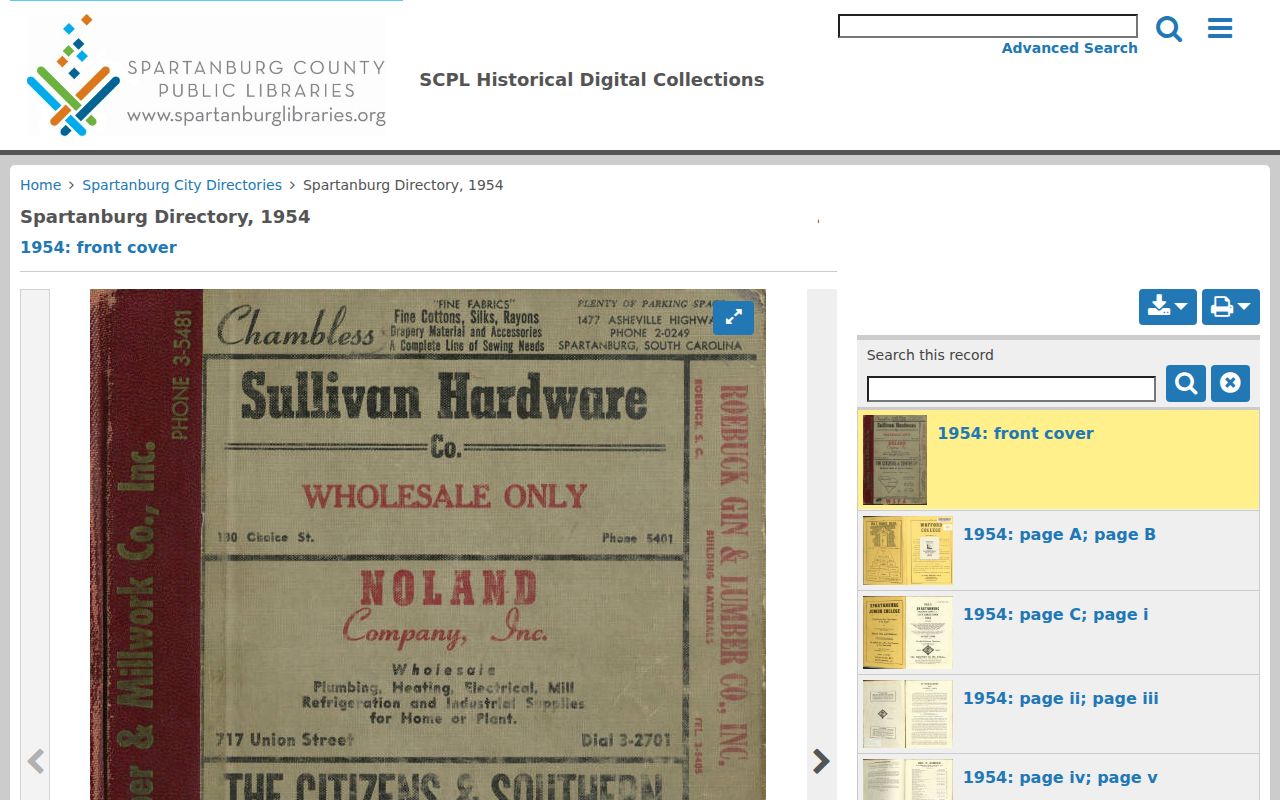
The scan shows why a citation needs its edition and page: a printed directory is a fixed historical source, not a current household roster.
| Surname-first headword | Groups entries by family name, followed by initials or given names. |
|---|---|
| Parenthetical name | Can supply a spouse reference that helps distinguish people with similar names. |
| Widow notation | wid identifies the directory's widow convention, not an independent vital-record finding. |
| Household line | h, a number, and an abbreviated street identify the residence notation used in the entry. |
| Trade or organization notation | Abbreviated affiliations need to be read with the volume's own key and full line. |
| Route or community wording | May point beyond a compact downtown address and should be copied exactly. |
Spartanburg Directory Room Access
The Kennedy Room at Spartanburg County Public Libraries Headquarters, 151 S. Church Street, is the main local counter for directory, genealogy, and local-history research. Its material includes books, microform, maps, clipping files, manuscripts, visual collections, historical material, and access to online genealogy databases. The collection does not circulate. Fragile or unprocessed material can be restricted. Staff can pull requested items before an appointment, which is valuable when the requested directory is not in the digitized run.
Appointments are recommended at least 24 hours ahead, while walk-ins receive help as space and equipment allow. The listed hours are Monday through Thursday, 9 a.m. to 8 p.m.; Friday, 9 a.m. to 6 p.m.; Saturday, 10 a.m. to 1 p.m. and 1:30 p.m. to 5 p.m.; and Sunday, 1:30 p.m. to 5 p.m. The listed Kennedy Room phone is 864-596-3508, with 864-596-3500 extension 1238 also listed. Confirm hours and a specific shelf request before visiting.
The following image comes from the SCPL digitized city-directory collection.
Online access is helpful for the identified volumes, while the Kennedy Room remains the practical route for a physical-only year or related microform.
Reading Spartanburg City Directory Entries
A city-directory line is concise by design. In the 1954 sample, surname-first headings, initials, parenthetical spouse names, widow notation, residence abbreviations, route or community wording, and abbreviated trade or organization terms can all occur on a single line. A careful transcription captures the spelling as printed, including initials and punctuation. Compare the full entry with nearby same-surname lines before treating it as the right person. The directory's ordered street and business portions provide an independent check within the same volume.
- Criss-cross directory
- A reverse or address-ordered part of a directory that is read by street and number rather than surname.
- Householder index
- An arrangement that points to a household head or address, depending on the publisher's format.
- Abbreviation key
- The volume's explanation of shortened terms. Read it before expanding an unfamiliar mark.
- Street section
- The ordered address portion that can connect a known place with its entry in that edition.
Do not turn one abbreviation into a larger claim than it supports. A line identifies what that edition printed at a particular time. It does not independently prove a continuing address, current presence, or relationship beyond the notation itself.
Spartanburg City Directory Street Sections
Ordered street material is the reverse-directory layer available in the documented city-directory collection. It is useful when a historic house number or street is the starting point. Locate the street section for the right year, record the page, then compare the alphabetical entry for the same household. That two-part check reduces errors caused by abbreviated streets, closely matching surnames, or a route label that looks like a modern postal address.
Street notation should remain tied to the directory edition. County GIS now assigns and maintains structure addresses, streets, road centerlines, and address ranges, but the research found no verified countywide renumbering year. When an older printed address does not match a current one, compare the street name, subdivision or lot wording, plats, and dated sources. The Spartanburg street directory provides the modern parcel-and-address route after the historical address has been narrowed.
Tracing Spartanburg City Directory Families
Household tracing works best as a dated sequence rather than a one-volume lookup. Start in the alphabetical portion if a surname is known, or in the ordered street portion if an address is known. Record the spelling, volume year, address, spouse or widow marker, route or community notation, and page. Then use the next available printed or digitized directory. An apparent disappearance may reflect a move, death, a spelling change, a gap in the selected online run, or a volume that must be checked at the Kennedy Room.
- Find the first available Spartanburg directory entry and copy its edition, page, exact name form, and address notation.
- Check adjacent available directory years, noting every address change and each change in spouse, widow, or community wording.
- Use the ordered street material to test whether the address and surname point to the same household in that volume.
- Pair the directory period with the nearest public federal census. Public schedules run through 1950, while Kennedy Room access is documented through 1940.
- Use a dated obituary citation, probate file, or recorded deed only after the directory trail identifies a focused name, date, or address question.
That sequence makes uncertainty visible. A city directory can show a household at a printed address in one edition. A census groups people at a decennial point. A deed records a property transaction. Using the sources together is stronger than treating any one as a complete family record.
Note: A missing year in the selected online collection should prompt a Kennedy Room shelf check before a family trail is closed.
Spartanburg Obituary Index Citations
The Kennedy Room death and obituary index begins with a July 17, 1844 issue of the Carolina Spartan. It is a citation index, not the newspaper image itself. Searches can use surname, first name, alternate name, spouse, age, and location. A result can supply date, page, source, and death information, giving a focused reason to consult microfilm or order a copy. The documented index has a 1923-1929 gap, so an empty result in that period is not a conclusion.
The source below comes from the Kennedy Room obituary-index access point.
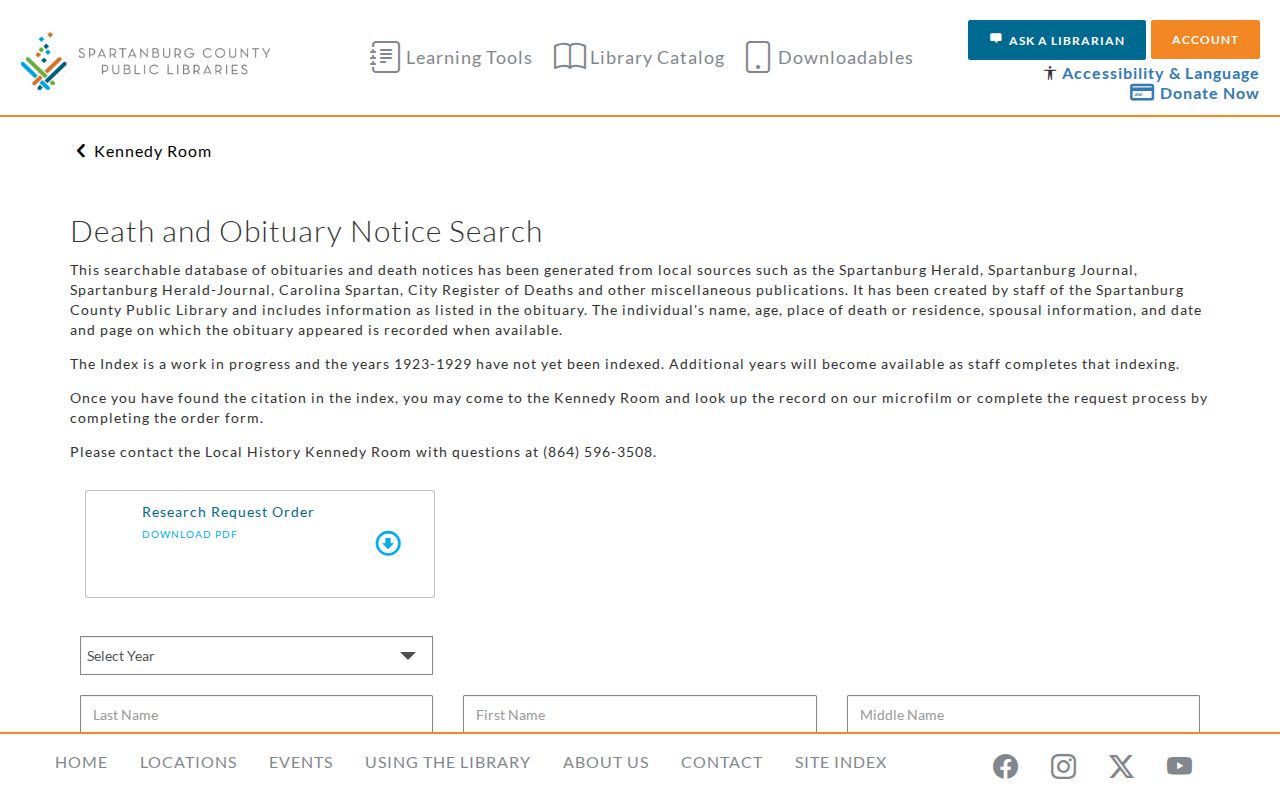
An obituary citation can carry a historical directory lead into newspaper microfilm, then to a probate or recorded-property question when the dates and name variants align.
Kennedy Room research requests provide an offline channel for named checks of probate and land indexes, Confederate service records for particular soldiers, and Herald or Herald-Journal newspaper indexes. The published request cost is $5 plus $0.50 per photocopied page, including shipping and handling, with prepayment and an estimated two-week turnaround. Rush processing within three business days carries extra charges. This is a focused option when a digitized entry identifies a precise question but the needed local material is not online.