
Spartanburg Resident Lookup Records
There is no official master roll of every person in Spartanburg County. Each source answers a narrower question. The Assessor record can connect a named owner or taxpayer to a parcel and its tax fields. A Register of Deeds instrument records a party’s role in a transaction. Court, Probate, voter, and vital records serve different purposes and carry their own access rules. Start with the record most closely keyed to the fact already known, then confirm it with an independent record before drawing a conclusion about a person.
| Record | What It Confirms | Where | Access |
|---|---|---|---|
| CAMA assessment record | Parcel, owner or taxpayer fields, property location, tax mailing field, and deed pointers | Spartanburg County Assessor Property Records Search / QPublic | Free, but tax data can lag a recorded deed |
| Recorded instrument | Party role, instrument date, legal description, and book/page or instrument number | Spartanburg County Register of Deeds | Free portal images within stated coverage periods |
| Court case | Party, case number, court context, status, and public docket history | Seventh Judicial Circuit / Spartanburg County Public Index | Public results subject to sealing and redaction |
| Voter registration | A verified voter’s registration and precinct context | MySCVotes / Check My Registration | Name, county, and date of birth match required |
| Vital or probate record | Limited event or estate context | SC DPH or Spartanburg County Probate Court | Eligibility and historical-access rules apply |
A property result should not be read as proof that someone currently lives at the site. The CAMA data separates OwnerName from TaxpayerName, and the county separates a property location from tax mailing fields. In the same way, a recorded party can be a signer, grantee, grantor, or other document participant without being a present resident. The useful habit is simple: identify what the record actually labels, note its date, and seek a second source that addresses the same period.
Verify a Spartanburg Record Trail
A full name plus a known street, approximate year, or document number is a stronger starting point than a broad name search. For a parcel lead, record the property location, parcel identifiers, tax fields, legal description, deed book/page or instrument number, and sale reference. Move next to the deed index and read the document’s party role, date, type, and legal description. The county cautions that its assessment data can take months to reflect a recorded transfer, so the deed is the county’s official ownership record.
- Write down the minimum known facts, including spelling, a time window, and the county connection.
- Use the source keyed to that fact, such as a parcel search for a property lead or a case number for a court lead.
- Read the identifying context: middle initial, party role, legal description, county, and dates all help separate similar names.
- Confirm a second independent point, such as an obituary citation beside a probate case number or an old directory entry beside a deed description.
- Keep same-name results separate when the time, role, or place conflicts.
Name variants are common in older instruments and directories. The Register of Deeds search options, historic index books, spouse or widow notations, and the Kennedy Room obituary index’s Alternative Name field can all help test a variation. They are reasons to investigate, not reasons to merge two people automatically. The Kennedy Room’s local obituary index has a real gap from 1923 through 1929, so an absent entry in that interval should remain an unresolved absence.
Read Spartanburg Public Index Results
The state Public Index is the name and case-search route for Spartanburg County. Select the county first, then use the displayed court or agency filter when it helps. A case number is the most precise query when known. For names, the published controls allow Begins With and Contains searches, which are useful for a spelling variation without pretending that a partial match identifies a person. The live system requires browser cookies and JavaScript, and its available court or agency choices can change by screen.
A normal result or docket can include a case caption and party names, case number, court or agency, status, type or subtype, filing and action history, action codes, and hearing or roster context. Where a county uses e-filing, public document availability may be tied to that system. Court records can clarify a specific proceeding, but they are not an address directory. Sealed, expunged, family, adoption, juvenile, confidential, and properly redacted material has additional limits. Federal cases are outside the state index.
- Docket
- A docket is the court’s running list of filings, actions, and scheduled events for one case. It is not a finding about a person outside that case.
- Index and image
- An index points to a record by fields such as party, date, or case number. An image is the scanned document itself, and may have different availability or copy rules.
- Certified copy
- A certified copy is issued by the record custodian with its certification. It is different from a search result, a screen display, or an informational copy.
Use Spartanburg Vital Records Limits
SC DPH vital records are not a general name-search catalog. Birth records become public after 100 years, while death records become public after 50 years. Before those public periods, certified-copy access is limited by eligibility rules. Marriage licenses are held through Spartanburg County Probate Court, while a state marriage certificate follows a separate DPH channel. A divorce court file follows the Clerk of Court and Family Court process, and a Public Index result can be only a starting point.
For historical work, the Kennedy Room has a South Carolina death-certificate index for 1915 through 1959 and microfilm for 1915 through 1966. Its newspaper death and obituary index begins with the July 17, 1844 Carolina Spartan and continues into current Herald-Journal material, apart from the unindexed 1923 through 1929 period. An obituary citation can supply a date, page, and source for a later Probate or deed search. It does not turn an historical citation into an unrestricted current-person search.
Trace a Spartanburg Probate Lead
An estate trail begins with a decedent and a date, not with an assumption about living relatives. Probate records can provide estate-case, will, administration, and potential heir context when the file and access rules allow it. For a physical-file request, Probate asks for the decedent, case number, clerk, and active or closed status. Follow the file’s own information to the appropriate Clerk, Register of Deeds, or library source. A name mentioned in an estate file needs its role and time period preserved.
The county’s Probate Court is the source for the court view shown below. Its local role makes it a better follow-up for an identified estate than a broad search for a living person.
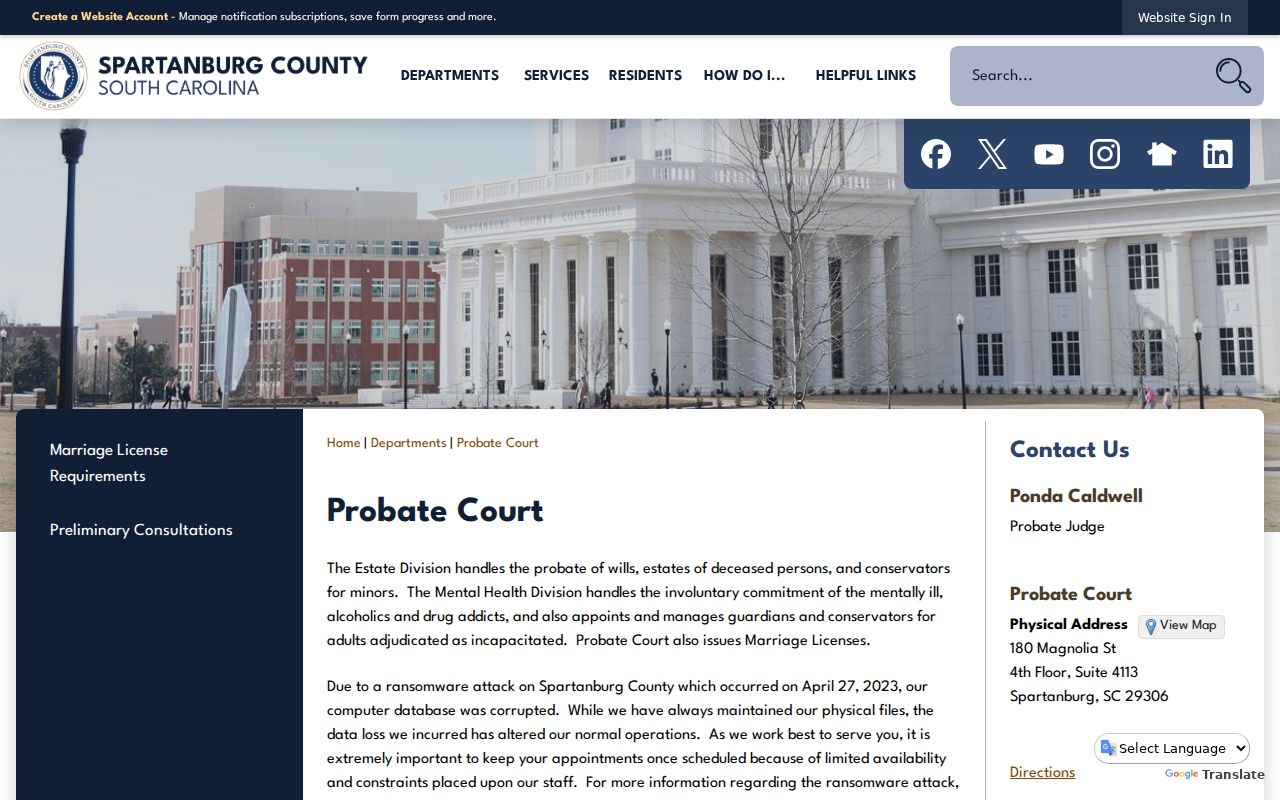
Keep the probate case reference beside the obituary or recorded-property reference that led to it. That preserves a checkable path without treating a possible heir, personal representative, or recorded party as proof of a present address.
Separate Spartanburg Agency Records
Agency records describe their own events and conditions. They should never be used to label someone beyond the limits of the official record. Booking information can change quickly and does not establish guilt, a current residence, or a person’s identity outside the agency record. Court status and disposition belong to the court file. The safest reading is limited, dated, and tied to the agency that published it.
The Spartanburg County Sheriff’s Detention Services Division provides the source view below. It is an agency context, not a personal profile or a substitute for a court record.
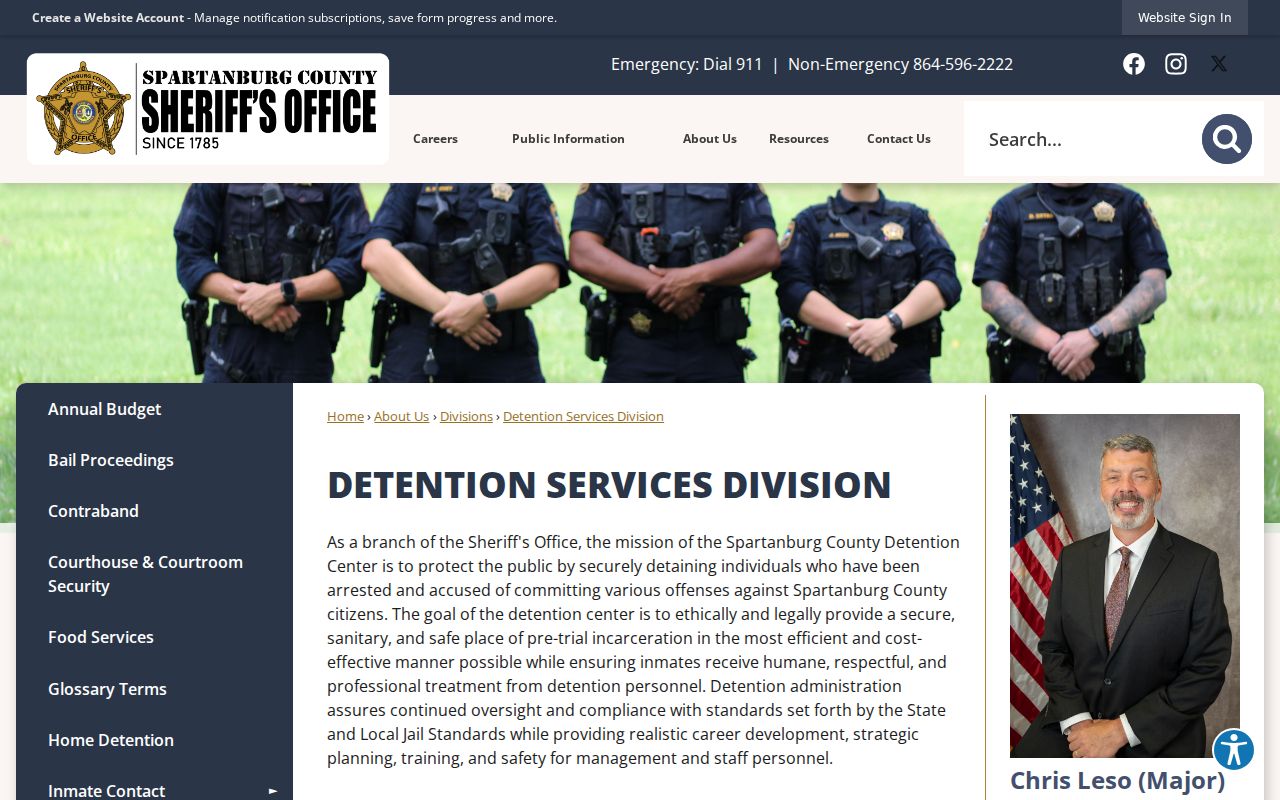
When a court case exists, use the case number, county, court agency, and dated docket entries to understand the proceeding. Do not convert a booking screen into a claim about a person’s character, residence, or outcome.
State registry material is also governed by the conditions and current information supplied by its custodian. The SLED registry provides the source view below. A registry check is not a broad neighbor-finding method and should be used only for lawful safety purposes under its stated terms.
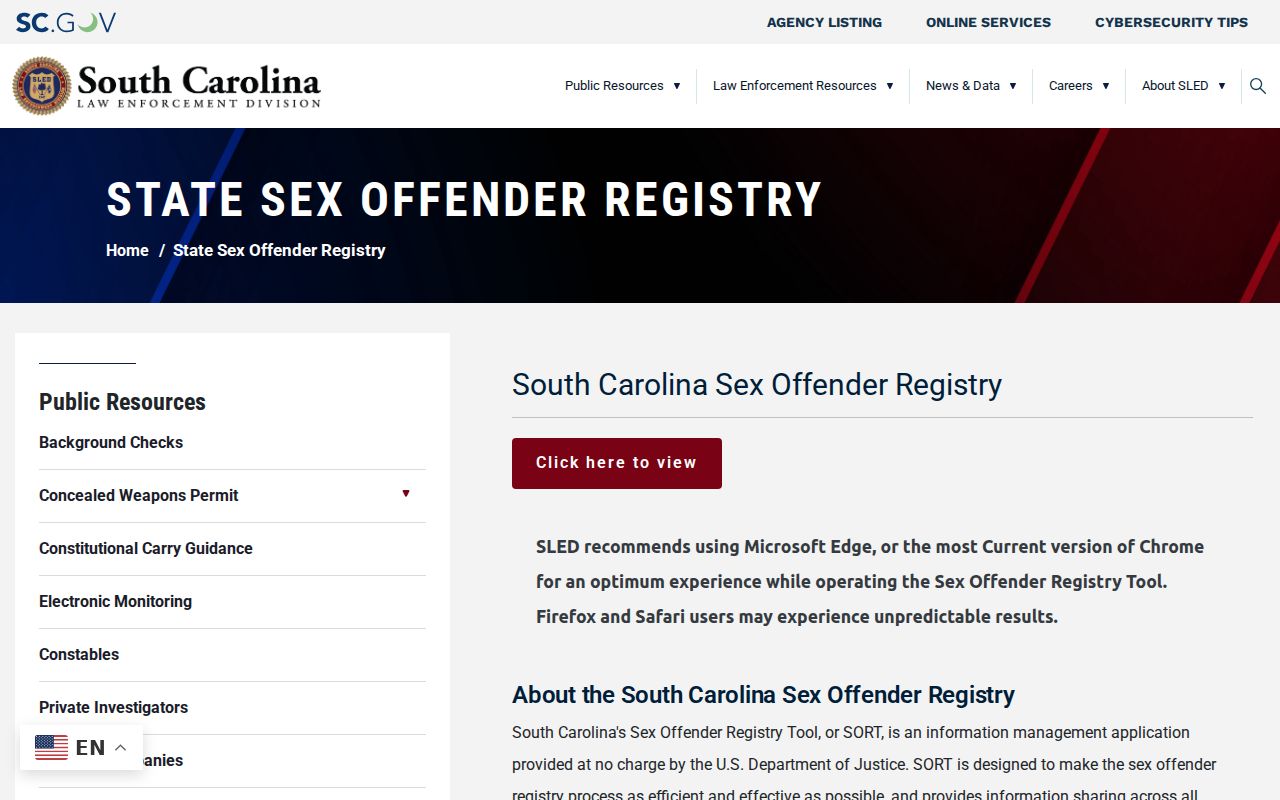
Read any official registry entry in its full, current context. Do not use it to harass, threaten, or identify a household from an address fragment.
Confirm Spartanburg Civic Status Carefully
MySCVotes / Check My Registration is an individual verified route, not an open name or street directory. It requires the name, county, and date of birth exactly as they appear on the voter-registration card. The verified service can provide the voter’s registration context and related services after the match. Registration at an address answers a limited civic question for a period. It does not identify every person at that address or disclose ballot choices.
The statewide list-sales program is a different channel. It is limited to registered South Carolina voters and has stated request criteria, pricing, and use conditions. Although its requests can use geographic and household criteria, it is not a substitute for the individual verification route. South Carolina also warns that personal information obtained from a public body may not knowingly be obtained or used for commercial solicitation directed at a person in the state.
Check Spartanburg Entity Records
For a question about an organization rather than a person’s residence, South Carolina Secretary of State Business Entities Online can show entity status and registered-agent or registered-office information. The state cautions that it does not hold names and addresses for every officer or director, and some business forms do not file there. A local Register of Deeds Trade Name or DBA instrument can be a separate recorded clue when one exists, but it is not a complete statewide directory.
Professional credentials should be checked through the relevant South Carolina LLR board’s live lookup. Board screens commonly use a name or license number and publish only the fields the board makes available. Use the result for current credential status where shown, not as a broad identity match. An entity, agent, credential, or office field has a specific legal role and should be described that way.
Respect Spartanburg Resident Privacy
Some missing information is protected by law, not absent by mistake. South Carolina’s Address Confidentiality Program gives eligible participants a designated substitute address for use with state, county, city, and court agencies. It is free, forwards specified mail, and does not erase information already public or compel private companies to use the substitute address. The program has a statutory route for eligible survivors and other qualifying applicants; it is not an informal records-search option.
Since January 1, 2026, qualifying active or former judges and local certified law-enforcement officers may seek removal of specified home-address, personal-cell, and tax-map information from public state and local government websites. The Judicial Branch says home addresses no longer display on Public Index for new and existing cases. Sealed files, confidential reference lists, redacted identifiers, motor-vehicle information, and protected vital records have separate boundaries. A narrow South Carolina Freedom of Information Act request cannot override those protections.
Keep Spartanburg Lookup Claims Narrow
Generic commercial lookup tools often combine old address fragments and unverified associations from many sources. Their records do not correct a conflict in the county’s original instrument, court file, or assessment record. If an official record has an error or an identifier that should be redacted, contact the appropriate custodian. A publisher’s removal process affects that publisher’s display, not the underlying Register of Deeds, court, assessor, voter, or vital record.
Lawful use. Use a Spartanburg resident lookup for personal, historical, family, civic, or safety research that respects each record’s limits. Do not use any result to stalk, harass, threaten, or harm a person.